single_tensor.py
import svetoviz_webgpu as sv

data = torch.rand((4, 4, 256, 256), dtype=torch.float32)
sv.tensor(data, gap_size=10)Svetoviz supports torch.Tensor visualization exactly like standard NumPy arrays.
Use tensor() to project a single torch.Tensor into the 3D scene. The
gap_size parameter allows you to control the visual spacing between high-dimensional
slices, making it easier to identify patterns across tensors.
import svetoviz_webgpu as sv
data = torch.rand((4, 4, 256, 256), dtype=torch.float32)
sv.tensor(data, gap_size=10)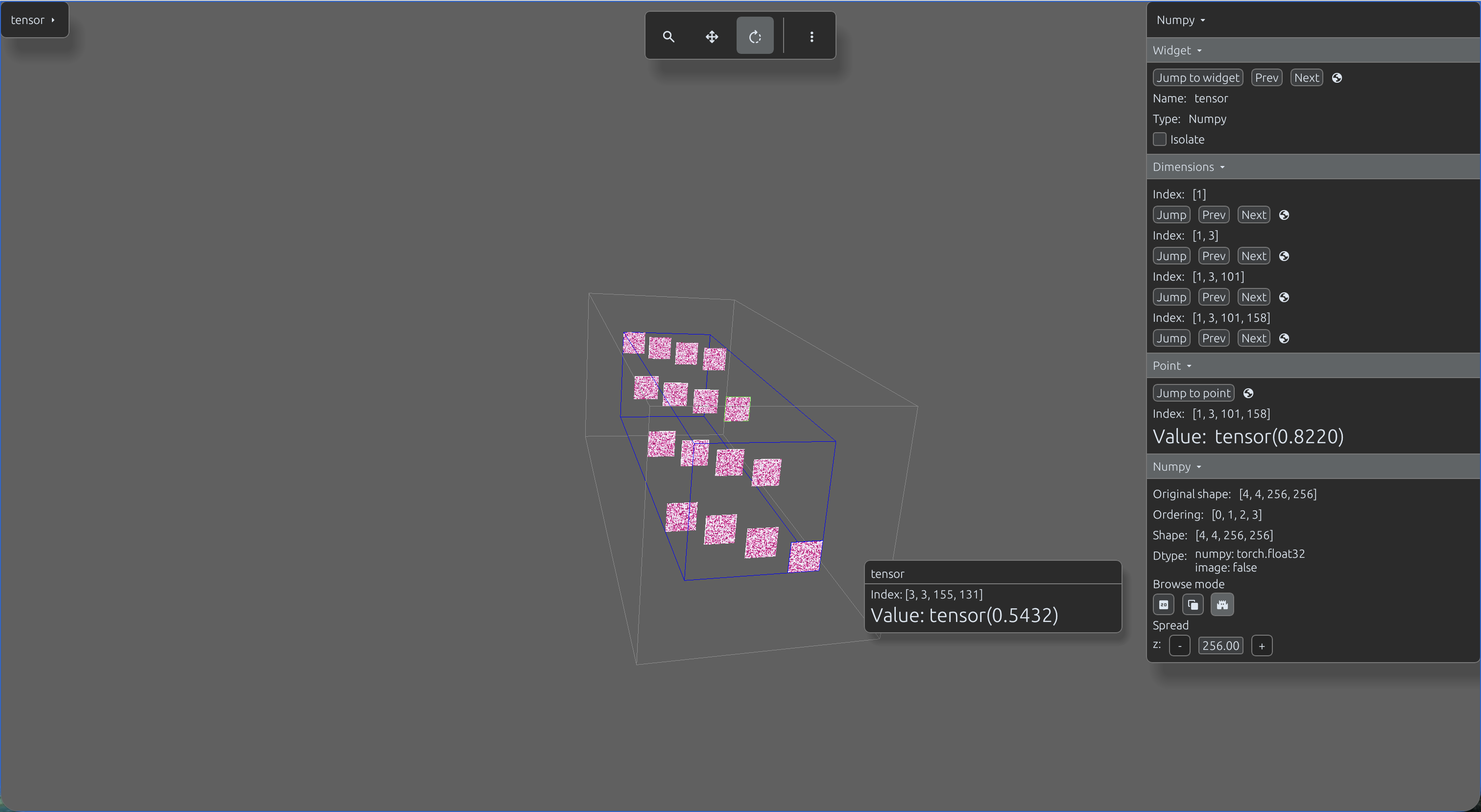
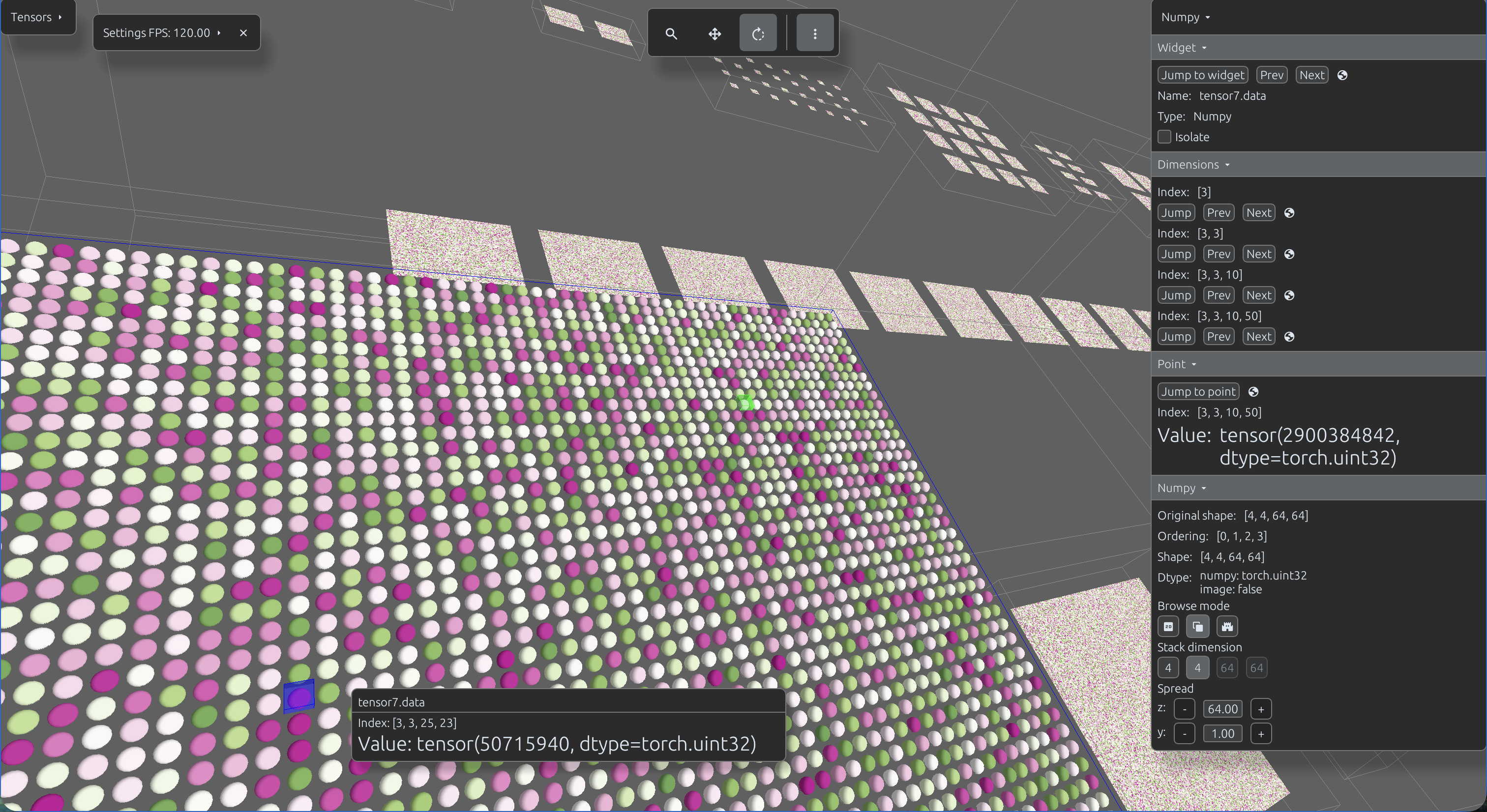
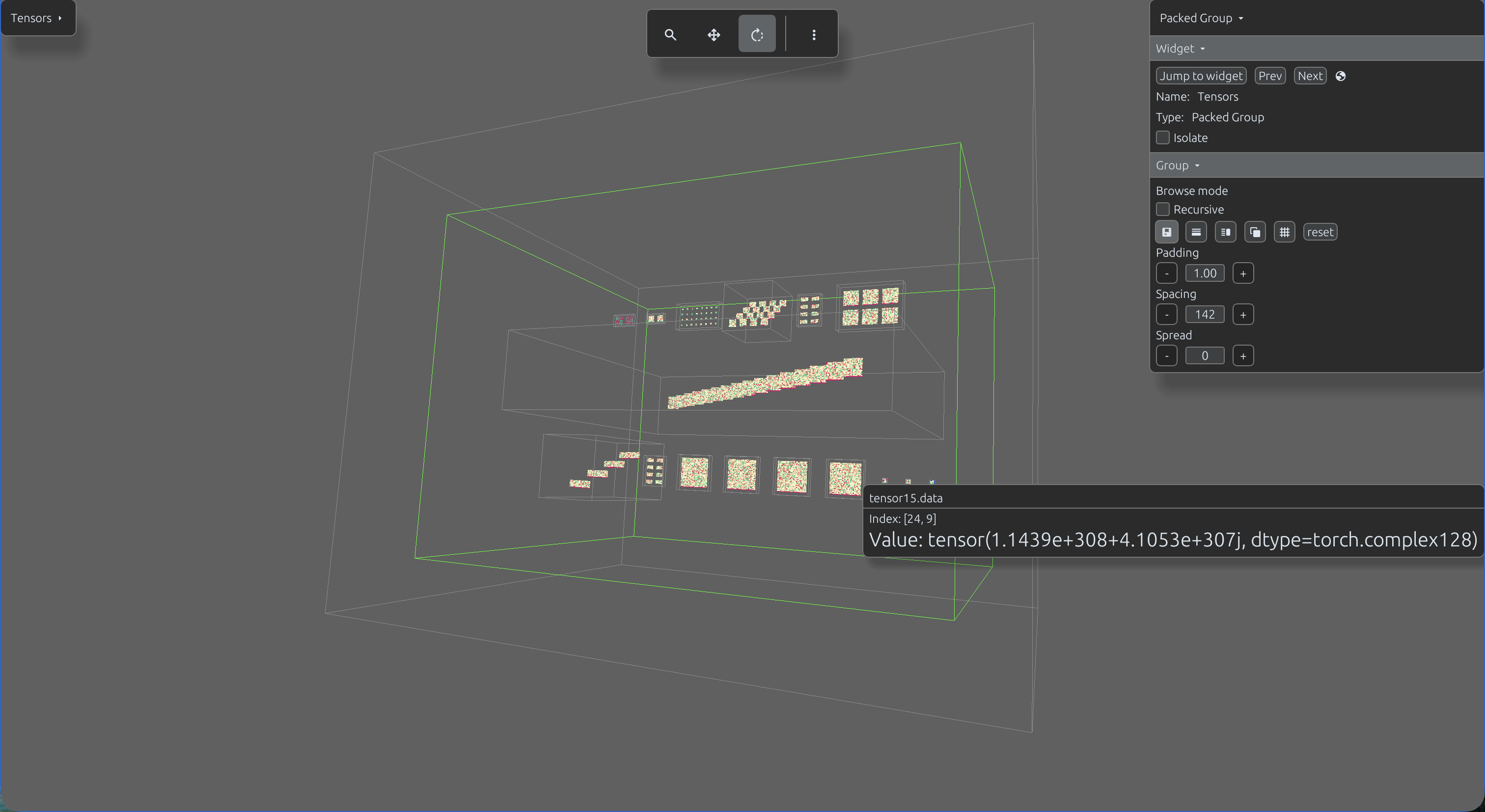
Svetoviz supports the full spectrum of torch dtypes - from standard integers and floats to complex
numbers and booleans. Using tensors(), you can pass a list of torch.Tensor with varying
shapes and types.
import svetoviz_webgpu as sv

sv.tensors([
    # integers
    torch.randint(0, 2, (2, 72, 72), dtype=torch.bool),
    torch.randint(np.iinfo(np.int8).min, np.iinfo(np.int8).max, (2, 60, 60), dtype=torch.int8),
    torch.randint(np.iinfo(np.int16).min, np.iinfo(np.int16).max, (4, 8, 16, 16), dtype=torch.int16),
    torch.randint(np.iinfo(np.int32).min, np.iinfo(np.int32).max, (4, 4, 64, 64), dtype=torch.int32),
    torch.randint(np.iinfo(np.int64).min, np.iinfo(np.int64).max, (4, 2, 32, 64), dtype=torch.int64),
    torch.randint(np.iinfo(np.uint8).min, np.iinfo(np.uint8).max, (2, 3, 128, 128), dtype=torch.uint8),
    torch.randint(np.iinfo(np.uint16).min, np.iinfo(np.uint16).max, (16, 128, 128), dtype=torch.uint16),
    torch.randint(np.iinfo(np.uint32).min, np.iinfo(np.uint32).max, (4, 4, 64, 64), dtype=torch.uint32),
    torch.frombuffer(np.random.bytes(4 * 2 * 32 * 64 * 8), dtype=torch.uint64).reshape(4, 2, 32, 64),

    # floats
    (torch.rand(256, 256, dtype=torch.float32) * torch.finfo(torch.float16).max).to(torch.float16),
    (torch.rand(256, 256, dtype=torch.float32) * torch.finfo(torch.bfloat16).max).to(torch.bfloat16),
    (torch.rand(256, 256, dtype=torch.float32) * torch.finfo(torch.float32).max).to(torch.float32),
    (torch.rand(256, 256, dtype=torch.float64) * torch.finfo(torch.float64).max).to(torch.float64),

    # complex numbers
    torch.complex(
        torch.rand(32, 32),
        torch.rand(32, 32)).to(torch.complex32) * torch.finfo(torch.complex32).max,
    torch.complex(
        torch.rand(32, 32),
        torch.rand(32, 32)).to(torch.complex64) * torch.finfo(torch.complex64).max,
    torch.complex(
        torch.rand(32, 32),
        torch.rand(32, 32)).to(torch.complex128) * torch.finfo(torch.complex128).max
], gap_size=32)
torch.Tensor visualization inherits all features from standard NumPy views, including stacking, ordering, colormaps, and large tensor support. TensorView is also the primary view used for rendering PyTorch models.